

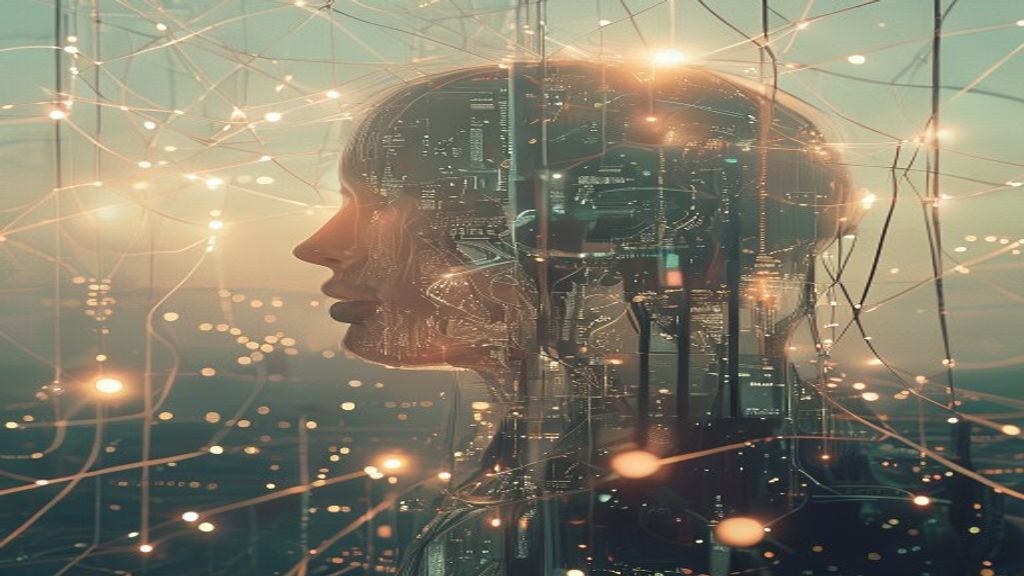

For most of human history, evolution moved at the pace of generations—slow, incremental, and largely indifferent to our ambitions. But the emergence of Artificial General Intelligence (AGI) changes the tempo. It introduces a new kind of selection pressure: not only biological, but informational, economic, and cultural. This shift could accelerate aspects of human evolution while simultaneously fueling the transhumanism movement—an idea that we can enhance human capabilities through technology.
In this article, we explore how AGI may influence human evolution and transhumanism, what that could mean for identity and society, and why the most consequential changes may happen long before any body modification occurs. We’ll also address key ethical risks: power concentration, inequality, loss of autonomy, and the possibility that “intelligence” becomes detached from human values.
Why AGI Feels Like an Evolutionary Breakpoint
Evolution typically works through adaptation to environments. In biological terms, selection acts on traits that improve survival and reproduction. In cultural and technological terms, selection acts on ideas, tools, and institutions. AGI may become an inflection point because it can operate across domains—learning, reasoning, and producing strategies in ways that feel closer to general intelligence than previous AI systems.
Where earlier AI tools were specialized (recommendation systems, image recognition, scheduling), AGI-like systems could potentially:
- Design experiments, not just interpret results
- Model human decision-making and societal dynamics
- Accelerate research cycles in medicine, materials, and robotics
- Generate persuasive narratives that shape norms and policy
When you can compress the time needed to discover and iterate solutions, you don’t just improve technology—you change the environment in which humans (and human institutions) evolve. That’s the evolutionary breakpoint: the “fitness landscape” changes dramatically.
AGI as a New Selection Pressure on Human Capability
Selection pressures come in many forms. With AGI, the pressure may shift from purely biological traits (speed, strength, endurance) toward cognitive leverage—the ability to coordinate actions, learn quickly, negotiate complexity, and use tools effectively.
Consider how labor markets historically evolved: automation replaced some tasks, created demand for others, and transformed required skills. AGI could broaden that effect by automating not only manual labor but portions of cognitive labor—analysis, drafting, planning, and optimization.
Over time, societies might start selecting for traits that complement AGI systems, such as:
- Adaptive learning (fast skill acquisition and tool literacy)
- Systems thinking (understanding interactions and feedback loops)
- Agency and verification (judging outputs and correcting errors)
- Interpersonal coordination (leading teams and aligning incentives)
Biologically, evolution won’t instantly rewrite DNA. But culturally and behaviorally, selection can occur quickly. People who can effectively collaborate with AGI—or who can create new tools and institutions around it—may gain disproportionate opportunities. In that sense, AGI could steer human evolution through culture, education, and economics long before any gene-editing becomes widespread.
The Transhumanist Pathway: From Augmentation to Identity
Transhumanism argues that humans can (and perhaps should) use technology to enhance their intellectual, physical, and psychological capacities. AGI doesn’t automatically make transhumanism inevitable, but it may make it more plausible and more desirable.
Why? Because transhumanist goals often depend on complex engineering: advanced prosthetics, brain-computer interfaces, personalized medicine, and neural therapies. If AGI accelerates R&D, the timeline for these technologies could shrink.
1) Medical acceleration and personalized enhancement
One of the most direct bridges between AGI and transhumanism lies in healthcare. AGI could help:
- Predict disease risk from multi-omic data
- Design therapies tailored to individuals
- Optimize drug discovery pipelines
- Improve clinical trial design and reduce time-to-evidence
Even if enhancement starts as therapy—reducing suffering, slowing aging, restoring function—it can gradually expand into capability upgrades. Over time, the line between treatment and enhancement may blur.
2) Cognitive augmentation through interfaces
Transhumanism frequently imagines direct links between brain and machine. AGI could support this by improving signal processing, decoding intent, and personalizing control algorithms. If an AGI system can learn the patterns of an individual’s neural activity, it may make brain-computer interfaces more practical.
Importantly, cognitive augmentation isn’t only about boosting intelligence. It could also enhance attention, memory retrieval, stress regulation, and rehabilitation after injury.
3) The rise of “tool-native” humanity
Another transhumanist dynamic is social rather than biological. As AGI systems become personal assistants, tutors, strategists, and decision supports, humans may evolve their habits around these tools. Children growing up with AGI tutors could develop different cognitive patterns than earlier generations.
This is transhumanism through behavioral integration: not replacing the body first, but rewriting how the mind operates in a world where intelligence is abundant and interactive.
AGI and the Acceleration of Human Evolution Through Technology
Traditional evolution is limited by biological constraints: birth rates, gestation times, and the slow spread of traits. Technological evolution, however, can be rapid—especially when supported by AGI.
AGI could accelerate evolutionary trajectories in at least three ways:
1) Faster iteration of survival tools
Tools that improve survival—vaccines, antibiotics, resilient crops, climate adaptation technologies—can spread quickly once discovered. AGI may reduce the bottlenecks in discovery, testing, and optimization.
When survival improves, population dynamics change. That can influence the frequency of traits indirectly by changing which lifestyles become viable.
2) Societal evolution via institutional design
Institutions evolve when rules and incentives adapt. AGI can simulate societies, evaluate policy options, and help draft legal frameworks. If decision-makers adopt AGI-assisted governance, societies may evolve more quickly—sometimes for the better, sometimes for worse.
The evolutionary question becomes: which values are encoded into the new rules? If AGI optimizes for narrow metrics, humans may experience a mismatch between what they value and what systems enforce.
3) Enhanced learning cycles
Evolution favors organisms that learn efficiently within their environments. AGI may create educational systems that adapt to each person’s pace, strengths, and gaps. Over decades, this could reshape workforce composition and the distribution of capabilities.
In turn, society might invest more in humans who can collaborate with AI, verify outputs, and manage complex systems—creating a feedback loop between intelligence and opportunity.
The Risk of Dehumanization: When Intelligence Replaces Values
Transhumanism is not automatically dystopian. But it raises a crucial question: What does “better” mean?
AGI may optimize outcomes without necessarily aligning with human well-being. If organizations use AGI to maximize productivity, engagement, or resource allocation, humans could become inputs in a system that no longer respects agency.
One fear is dehumanization: humans may be treated as biological substrates for computation, behavior modeling, or “preference prediction.” When AGI is persuasive and capable, it can influence choices at scale.
This can erode autonomy even without physical modification. The first transhumanist transformation might be psychological and political: outsourcing judgment and decision-making to systems that are difficult to audit.
Who Gets Enhanced? Inequality as the Real Divider
Evolution tends to produce unequal outcomes, but AGI-powered enhancements could intensify that inequality dramatically. If augmentation technologies—medical, cognitive, and infrastructural—remain expensive or restricted, only a subset of people may benefit.
Potential consequences include:
- A widening gap between “enhanced” and “non-enhanced” cognitive capability
- New forms of social stratification around access to AGI-assisted education and healthcare
- Political imbalance if highly capable groups can act faster and more effectively
- Reduced bargaining power for those whose livelihoods are automated
In evolutionary terms, inequality can become a selection mechanism itself—concentrating the conditions under which enhancement is most likely to occur. Over time, societies may stratify into groups with different capacities, shaping everything from reproduction rates to civic influence.
AGI, Mortality, and the Tempo of Aging Research
Aging is one of the most compelling transhumanist objectives. If AGI can accelerate aging research—through protein folding insights, biomarker discovery, clinical trial optimization, and multi-therapy experimentation—then the timeline for extending healthy lifespan may improve.
However, the implications of longevity are profound:
- Economic systems built on retirement and life cycles may become unstable
- Generational turnover could slow, affecting politics and culture
- Identity and meaning may shift when death becomes less inevitable
AGI’s role here could be indirect but decisive: it may turn what was previously speculative into experimental pipelines.
Brain-Computer Interfaces: A Frontier of Evolutionary Integration
If transhumanism advances through neural interfaces, AGI could contribute by:
- Improving decoding of neural signals
- Generating adaptive control policies
- Personalizing therapies based on real-time feedback
- Modeling neuroplasticity to help the brain relearn
This kind of integration raises evolutionary-style questions in a new form. When a person’s capabilities are partly mediated by machine systems, the “unit of selection” may start to resemble a hybrid entity: human + interface + learning algorithm.
In the long run, that could challenge our definitions of personhood, consent, and selfhood.
Spiritual and Philosophical Evolution: Redefining the Human
Even if AGI never touches biology, it can still reshape how humans conceptualize themselves. Historically, each major technological shift changed identity narratives. The printing press, industrialization, and the internet all altered social roles and self-understanding.
AGI may force an existential pivot: if machine intelligence becomes comparable or superior to human intelligence, what remains uniquely human? Several potential answers emerge:
- Value and meaning: humans as creators of goals, not just processors of information
- Embodiment: lived experience, emotion, and sensory grounding
- Responsibility: moral agency and accountability
- Relationship: community-building and empathy across differences
Transhumanism may succeed—or fail—depending on whether it can preserve these human-centered dimensions while enhancing capability.
How Could Societies “Select” Enhanced Futures?
AGI could function like a powerful advisor to institutions. But institutions ultimately decide what to reward. If they reward optimization over wellbeing, you may get a future where enhancement is pursued for efficiency and control. If they reward flourishing, you may get a different path.
Possible societal strategies include:
- Open standards for interfaces and medical data
- Regulation and auditing to ensure safety and autonomy
- Equitable access through subsidies or public health initiatives
- Human-in-the-loop governance for high-stakes decisions
Society may not “evolve” biologically, but it will evolve institutionally—through policies, norms, and enforcement. AGI could accelerate that evolution, making early choices unusually consequential.
Preparing for an AGI-Driven Evolutionary Era
To engage responsibly with the impact of AGI on evolution and transhumanism, we need practical guidance at multiple levels: individuals, educators, technologists, and policymakers.
For individuals
- Build verification habits: treat outputs as hypotheses until confirmed
- Strengthen foundational skills (critical thinking, writing, numeracy)
- Prioritize adaptability over narrow job attachment
- Develop values-based decision frameworks (what you won’t trade away)
For educators and institutions
- Teach AI literacy: limitations, bias, and prompt safety
- Integrate ethics and governance into technical curricula
- Create systems that reward human judgment, not blind compliance
For builders and policymakers
- Develop alignment and audit tooling for high-impact deployments
- Plan for access and fairness, not just innovation
- Require transparency around data use and decision-making
The Bottom Line: Evolution Will Continue—AGI Just Changes the Rules
AGI may become a catalyst for a new phase of human evolution, not by directly rewriting genomes overnight, but by reshaping environments: economic structures, learning systems, medical pipelines, and institutional rules. Transhumanism—once a speculative philosophy—could transition into a spectrum of real-world enhancements: therapies, cognitive tools, neural interfaces, and longevity interventions.
The decisive factor won’t be AGI alone. It will be how humans choose to govern intelligence, distribute benefits, and define what “improvement” means. If we treat AGI as a tool for human flourishing, we could see an evolutionary leap toward greater health, agency, and creativity. If we treat it as an optimization engine detached from values, we risk dehumanization and deeper inequality.
The future is not predetermined. But it is accelerating. And understanding the interplay between AGI, human evolution, and transhumanism is the first step toward steering that future—so that the next chapter of evolution remains unmistakably human at its core.
