

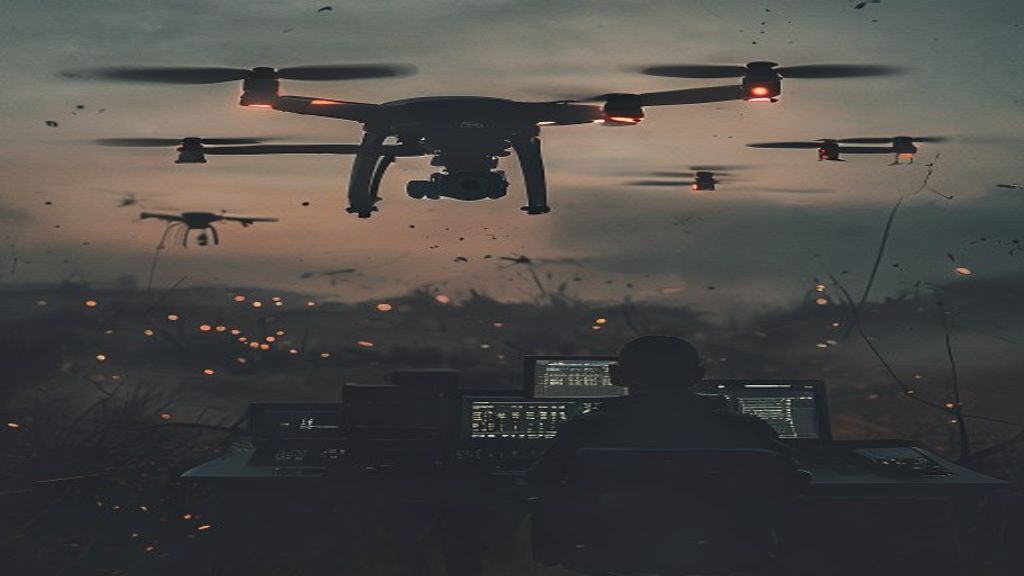

Autonomous AI agents are moving from sci-fi concept to real-world military capability. From drone swarms that can detect and track targets to decision-support systems that recommend actions in seconds, these technologies promise speed, scalability, and reduced human risk. But they also raise profound ethical questions: Who is responsible when an AI causes harm? How do we prevent unlawful or immoral targeting? And what does meaningful human control mean when machines can act faster than humans can intervene?
This article explores the ethics of autonomous AI agents in warfare through the lenses of international law, moral philosophy, accountability, and practical safety. We’ll examine how autonomy changes the nature of warfighting, why existing frameworks strain under new capabilities, and what responsible governance could look like.
What Are Autonomous AI Agents in Warfare?
In military contexts, an autonomous AI agent is typically a system that can perceive its environment, interpret data, decide on actions, and execute those actions with varying degrees of human oversight. Autonomy can range from:
- Decision support: The system suggests options, but a human approves.
- Supervised autonomy: The system acts within constraints set by humans, with oversight triggers.
- Conditional autonomy: The system can select and engage targets under predefined rules, but may not require continuous human control.
- Full autonomy: The system independently performs the observe–decide–act loop and engages targets without real-time human involvement.
As autonomy increases, ethical risk often increases too—especially around errors, bias, escalation dynamics, and accountability for lethal outcomes.
Why Ethics Become More Complex as Autonomy Increases
In conventional warfare, humans directly observe, interpret, and decide. With autonomous agents, critical steps can shift to software. That shift changes ethical duties in several ways:
- From intention to inference: AI may infer targets and priorities from sensor data, which can be incomplete, noisy, or deceptive.
- From deliberation to optimization: Systems may be trained to maximize mission success metrics without fully capturing moral constraints.
- From visible error to hidden failure: An AI can fail in ways that are hard to detect, explain, or predict after deployment.
- From human context to pattern matching: AI might miss cultural, situational, or human-intent nuances that a soldier would consider.
These factors create a gap between ethical accountability and technical capability—a gap that must be addressed before autonomous systems are normalized.
The Core Ethical Questions
1) Accountability: Who Is Responsible?
When a lethal autonomous system makes a mistake—such as striking civilians, misidentifying a target, or violating rules of engagement—responsibility is not automatically clear. Ethics requires that accountability be assignable to identifiable parties, such as:
- Commanders who ordered deployment or set operational parameters
- Engineers and organizations that designed and trained the system
- Vendors and integrators who delivered components
- Operators who monitored or authorized actions
But autonomy can blur the causal chain. If an AI selects a target and fires within seconds, commanders may not have meaningful oversight. This raises a key ethical demand: systems must be auditable enough to reconstruct decisions after the fact. Without reliable logs, explainability, and investigation pathways, “accountability” becomes symbolic rather than real.
2) Human Control: What Counts as “Meaningful”?
International debate often centers on what “meaningful human control” means for lethal decision-making. Ethical concerns intensify when humans are reduced to either:
- Paper supervisors: approving systems but not monitoring operations
- Post-hoc reviewers: reacting after harm occurs
Meaningful control likely requires more than a checkbox. It may entail human involvement that is timely and informed, including the ability to:
- Set and understand constraints
- Interrupt or override actions when needed
- Understand the basis for target selection
- Assess uncertainty and confidence levels
Ethically, “humans on the loop” must be able to do something effective—otherwise the term becomes misleading.
3) Lawfulness: Can Autonomy Respect International Humanitarian Law?
International humanitarian law (IHL) governs conduct during armed conflict. Two principles are especially relevant:
- Distinction: Parties must distinguish between civilians and combatants.
- Proportionality: Attacks must not cause excessive civilian harm relative to the anticipated military advantage.
Autonomous agents face challenges here:
- Distinction may fail under uncertainty: Sensors can be fooled by camouflage, weather, or spoofing.
- Proportionality is context-dependent: Evaluating “excessive” harm often requires judgment about dynamic conditions.
- Targeting is not just identification: Legal compliance involves verifying intent, context, and expected effects—not merely detecting objects.
An AI can be trained to classify targets, but that does not automatically produce the moral and legal reasoning required for IHL compliance in every situation.
The Risk of Unlawful and Unethical Targeting
Misidentification and the Civilian Harm Problem
Autonomous agents rely on data—images, signals, trajectories, and classifications. If those inputs are wrong, the AI can be confidently wrong. Ethical warfare requires robust safeguards, yet several failure modes are plausible:
- False positives: Civilians or non-combatants misclassified as threats.
- False negatives: Real threats missed, leading to compensating actions that raise risk.
- Context blindness: The system may not recognize when an object is no longer a valid target.
- Sensor spoofing: Adversaries can manipulate inputs to trick AI models.
When autonomy scales to swarms, small error rates can translate into significant numbers of incidents, multiplying ethical consequences.
Bias, Training Data, and Unequal Harm
Ethics is not only about technical accuracy; it’s also about fairness and predictable outcomes. If training data reflects biased conditions, the system may perform differently across:
- Geographies (urban vs. rural)
- Lighting and weather environments
- Uniform styles and cultural markers
- Accessibility of high-quality data for certain regions
In warfare, uneven performance can translate into unequal civilian harm and uneven escalation risk. Responsible deployment must include rigorous evaluation across diverse conditions, plus a clear plan for remediation when performance degrades.
Escalation Dynamics: How Autonomy Changes Conflict
Autonomous agents may alter escalation in both intended and unintended ways. On the one hand, automation could reduce impulsive mistakes by sticking to constraints. On the other hand, autonomy can accelerate decision cycles and increase the speed at which engagements begin.
Key escalation concerns include:
- Speed mismatch: Machines act faster than humans can coordinate, communicate, or de-escalate.
- Ambiguity loops: AI may interpret signals as hostile, leading to defensive or preemptive strikes.
- Swarm behavior complexity: Large numbers of agents can produce emergent behavior that is hard to predict.
- Reduced deterrence clarity: If systems are partially unpredictable, adversaries may assume worst-case intent.
Ethically, any system that increases the likelihood of uncontrolled escalation must be treated with exceptional caution.
Transparency, Explainability, and the Right to Meaning
Modern AI ethics often emphasizes transparency—not because we want “perfect” explanations, but because accountability requires a basis for review. For autonomous weapons, explainability takes on an additional ethical dimension: understanding the decision rationale is essential to assess whether the system followed lawful and ethical rules.
However, many AI models—especially deep learning systems—can be difficult to interpret. This creates an ethical tension:
- Operational effectiveness may favor complex models that are hard to explain.
- Legal and ethical compliance demands reasoning that humans can verify.
Practical governance could include:
- Decision logs that capture sensor inputs and model outputs
- Confidence scores and uncertainty indicators
- Rule-based constraint layers that limit actions when confidence is low
- After-action audits with independent review mechanisms
Transparency should not be optional; it should be embedded into system design.
Security and Robustness: The Ethics of Failure Under Attack
Autonomous systems will operate in contested environments where adversaries may jam, spoof, or manipulate data. Ethical responsibility includes anticipating adversarial behavior rather than assuming benign conditions.
Robustness ethics asks: What happens when the system is attacked? Common risks include:
- Model manipulation: Inputs engineered to trigger misclassification.
- Data poisoning: Corrupting training pipelines to bias behavior.
- Command spoofing: Interfering with control signals or authorization flows.
- Denial of service: Causing the system to behave unpredictably when sensors fail.
Ethically, a system should default to safe behavior when uncertain or under interference. “Safe failure” is not merely a safety feature; it is a moral requirement when lethal outcomes are possible.
Do Current Legal Frameworks Fit Autonomous Agents?
International humanitarian law was developed for humans making decisions under uncertainty. Autonomous agents introduce a new variable: algorithmic agency. While IHL principles still apply, enforcement becomes harder.
Some difficulties include:
- Attribution challenges: Proving who intended what and which component caused the harm.
- Compliance verification gaps: Auditing training data and decision logic may be complex.
- Cross-border accountability: Systems may be developed in one country and used in another.
- Operational unpredictability: Machine learning systems can generalize beyond expected conditions.
Because the legal landscape is still evolving, ethical governance often requires going beyond minimal compliance and adopting precautionary principles.
Precaution vs. Innovation: The Moral Tradeoff
Critics sometimes portray autonomous weapons as purely reckless, while proponents argue they can reduce risk to soldiers and prevent some forms of human error. There are real potential benefits, including:
- Consistent application of rules within narrow constraints
- Reduced cognitive overload for operators
- Faster detection in time-sensitive threats
- Potentially lower casualty rates if discrimination improves
Yet ethical innovation should be measured against possible harms. The moral question becomes: Is the risk proportionate to the claimed benefit, and can it be governed responsibly?
When lethal outcomes involve high uncertainty, hard-to-explain decisions, and contested environments, the precautionary argument strengthens.
Policy and Governance: What Ethical Deployment Could Require
There is no single global consensus solution, but responsible governance could include several practical measures.
Clear Limits on Autonomy in Lethal Decisions
One ethical approach is to restrict the “observe–select–engage” loop for lethal force, requiring human authorization where feasible. If a system can initiate lethal action without meaningful human approval, ethical risk rises.
Human Verification and Override Capabilities
Governments and militaries could require:
- Real-time human ability to interrupt or redirect engagements
- Operator access to the system’s confidence and rationale
- Human confirmation steps for certain categories of targets
Ethically, the goal is not to slow operations but to ensure that humans can enforce moral and legal constraints.
Robust Testing, Including Adversarial Conditions
Ethical assurance would require rigorous evaluation before deployment, including:
- Testing across diverse environments and sensor conditions
- Adversarial simulations to evaluate spoofing and deception resilience
- Stress tests for degraded communications and partial sensor failure
Testing should also be independent where possible, to reduce the risk of vendor-driven optimism.
Auditability, Documentation, and Incident Investigation
Ethical deployment demands an evidence trail. At minimum, systems should provide:
- Detailed logs of sensor inputs, classifications, and actions taken
- Version control of models and training configurations
- Chain-of-custody and command authorization records
- Mechanisms for independent review and remediation
Without these, accountability becomes a matter of rhetoric.
Training and Accountability Structures for Operators
Ethics fails if operators are not trained to understand system capabilities and limitations. Programs should include:
- Human factors training for trust calibration
- Clear procedures for escalation, override, and abort
- Operational doctrine that acknowledges uncertainty
Humans cannot responsibly delegate morality to machines if they don’t understand how those machines behave under stress.
Debating Autonomous Weapons: The Positions You’ll Hear
To understand the ethics, it helps to recognize the major arguments on each side.
Pro-Autonomy Arguments
- Reduced risk to personnel: Less time in hostile zones for human operators.
- Consistency: Systems may adhere to rules more consistently than humans under fatigue.
- Improved detection: AI may identify threats faster than human perception.
Anti-Autonomy Arguments
- Accountability uncertainty: It’s hard to trace responsibility for harms.
- Unpredictable moral reasoning: Machines may not apply proportionality and distinction correctly in novel cases.
- Escalation risk: Faster engagements can reduce opportunities for de-escalation.
Ethical policy should not ignore either set of concerns; instead, it should seek a governance path that captures benefits while preventing irreversible harms.
A Human-Centered Ethical Bottom Line
Ultimately, autonomous AI agents in warfare raise a human-centered moral question: Should we allow systems without genuine moral agency to decide on lethal force? Even if AI can mimic aspects of decision-making, it does not experience consequences, does not hold intent, and does not share the moral responsibility that humans can bear.
A prudent ethical stance may look like this:
- Autonomy can assist detection and decision support, but lethal engagement should remain constrained.
- Human control must be meaningful—timely, informed, and able to override.
- Accountability must be technically supported through auditability and transparency.
- Precaution must guide deployment when uncertainty is high and environments are contested.
As autonomous systems become more capable, the ethical imperative is not to halt innovation, but to align capability with moral governance.
Conclusion: Ethics Is Not an Afterthought
The ethics of autonomous AI agents in warfare cannot be treated as a post-deployment compliance checklist. Autonomy changes the speed, structure, and accountability of decisions about harm. It challenges the practical enforcement of international humanitarian law and increases the difficulty of explaining errors.
The path forward should prioritize safeguards: limited autonomy in lethal decisions, meaningful human oversight, robust testing (including adversarial scenarios), and strong audit mechanisms. In a domain where errors can be irreversible, ethical responsibility must be designed into systems from the beginning—not added after tragedies occur.
If society wants AI-driven capabilities that reduce harm rather than amplify it, the question is not only what autonomous agents can do, but what we are willing to justify—and how we will ensure justice when something goes wrong.
